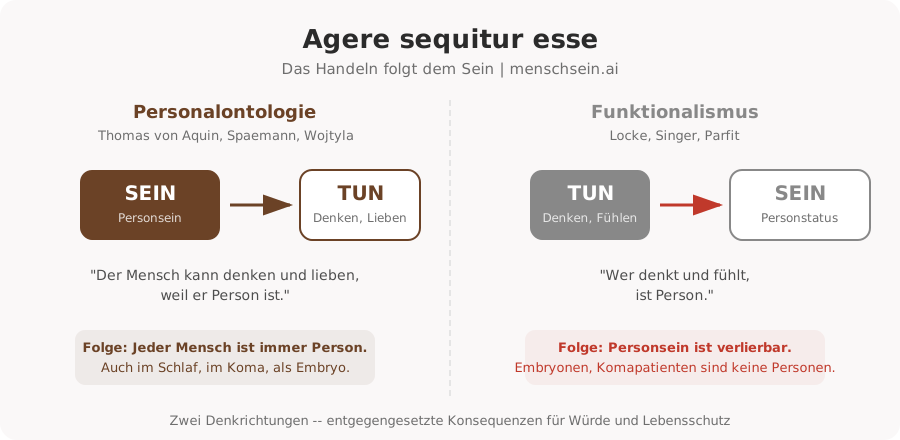
Agere sequitur esse — “Action follows being” — is a principle of Thomistic philosophy and a key tenet for understanding the relationship between personhood and person-behavior (Bexten 2017, pp. 195 ff.).
From the book
“What someone is and what someone does are two fundamentally different things. Personhood and person-behavior must be clearly distinguished. Existence comes before activity.”
— The Results at a Glance, Chapter 6
Significance for the ontology of the person
The principle states: the manner in which an entity acts follows from the manner of its being. A person acts personally because she is a person — not the other way around. Personhood is the ontological ground of person-behavior. Thomas von Aquin formulates it as operatio sequitur esse — operation follows being. Berthold Wald places this principle at the center of his rehabilitation of the concept of substance: being human is being a person, not an achievement first to be produced through acts.
Consequence: personhood precedes person-behavior
From this follows the central thesis of the book: the human being is not a person because he thinks, feels, or acts. Rather, he thinks, feels, and acts because he is a person. Reason, freedom, and self-consciousness are expressions of personhood, not its conditions.
Against functionalism
The empirical-functionalist concept of the person reverses this relationship: it makes actual activity (consciousness, rationality) the condition of personhood. Peter Singer and Derek Parfit advocate this position. In doing so, embryos and persons with dementia are declared to be non-persons. The Turing Test reveals the technological consequence of this error: if behavior is the criterion, then a sufficiently good simulation would have to count as “thinking.”
Act and potency
The principle is closely connected with the Aristotelian-Thomistic doctrine of act and potency: personhood is the act from which person-behavior proceeds as the actualization of potency. The nature of the person contains the faculties (potencies) that are actualized in action.
Three dimensions
The principle structures the three dimensions of personhood:
- First Dimension: substantial personhood (the esse)
- Second Dimension: rational, conscious action (the agere)
- Third Dimension: self-transcendence and affirmation
Sources: Generated by querying the Personhood ontology.
Further sources:
- Thomas Aquinas: Summa Theologiae I, q. 75, a. 3; De potentia q. 3, a. 7 (operatio sequitur esse).
- Aristotle: De anima II, 4, 415b (ἡ ἐνέργεια τοῦ ὄντος — operation follows being).