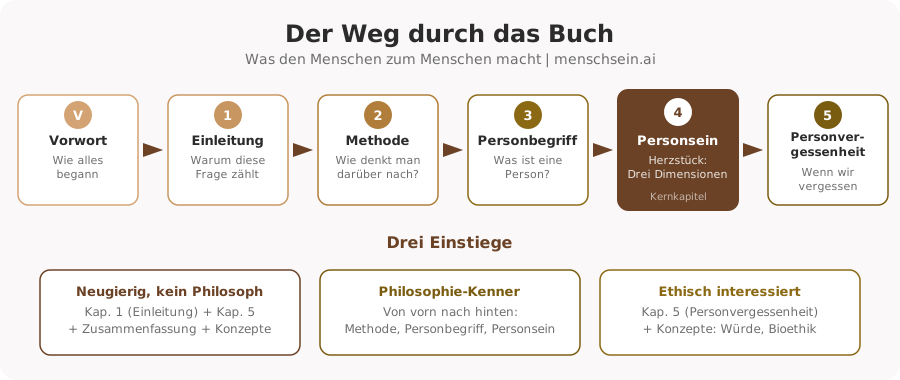
This book addresses one of the most fundamental questions of philosophy: What makes the human human? It brings classical metaphysics together with modern philosophy of the person — which can seem intimidating at first glance. It doesn’t have to be.
Here are three paths through the book, depending on your background and what you are looking for:
Path 1: I’m Curious, but Not a Philosopher
Dive straight into the text of the book:
- Why This Question Concerns Everyone — Your way into the book
- What It Means to Forget the Essence of the Human Being — The most striking chapter
- The Results at a Glance — The five core insights
Then look up whatever you want to go deeper into: Person, Dignity, Oblivion of the Person.
Core idea: Every human being is someone — not merely something. This insight has consequences for everything: from the question of how we treat embryos to whether artificial intelligence can ever be a person.
Path 2: I Know My Way Around Philosophy and Want to Understand the Argument
Follow the book chapter by chapter:
- Chapter 2: Method — Why phenomenology and metaphysics?
- Chapter 3: The Concept of Person — Three views of the person, and why the substance-ontological concept of person is superior to the empirical-functionalist one
- Chapter 4: Personhood — The three dimensions of human personhood
- Agere sequitur esse — The key proposition: acting follows being, not the other way around
Key thinkers: Thomas Aquinas, Robert Spaemann, Karol Wojtyła, Josef Seifert
Path 3: I’m Interested in a Specific Topic
| Topic | Where to start |
|---|---|
| When does human life begin? | Embryo, Fertilization, Act and Potency |
| Does a person with dementia lose their dignity? | Dementia, Ontological Dignity, First Dimension |
| What distinguishes the human being from the animal? | Human Person, Nature, Substance |
| Can an AI be a person? | Artificial Intelligence, Personhood, Body-Soul Unity |
| What is love — philosophically? | Love, Heart, Affirmation |
| What does freedom really mean? | Freedom, Will, Free Will |
| Is surrogacy ethically defensible? | Surrogacy, Personalistic Norm |
| What do the thinkers say? | Aquinas, Stein, Spaemann, Singer (opposing position) |
All concepts, systematically: All 364 Concepts at a Glance →
Technical terms explained in plain language: Glossary for Non-Philosophers →
The Most Important Thing in One Sentence
The human being is not a person because he can do certain things — he can do certain things because he is a person.
That is the core of the book. Everything else is the unfolding of this one thought.